
Embrace debate
The first committee rankings come out Tuesday. We'll spend the next five weeks doing a lot of arguing.

In Saturday’s Game Day Final, I wrote about all the things we believed to be true before the season kicked off and how wrong so many of those things turned out to be.
Instead, SMU stunned the Hurricanes 26-20 as Kevin Jennings threw for 365 yards and Carson Beck threw another deadly interception in overtime that proved Miami’s death knell. Three weeks ago, the Canes were undefeated and had, arguably, the most compelling résumé of any team in the country. But, of course, ever since Mario Cristobal sold his soul to a mysterious stranger at a crossroads in West Palm Beach in exchange for a supernatural cellphone that allowed him to become the world’s greatest recruiter, he has been afflicted with inescapably bad luck late in the season. The Canes are now 4-11 after Nov. 1 under Cristobal, including a 1-3 mark when ranked in the AP top 10.
Instead, Penn State was but a speed bump for Julian Sayin, Carnell Tate and Jeremiah Smith, as the Buckeyes breezed to a 38-14 win. The Nittany Lions lost for the fifth straight game, Penn State mustered just 200 yards of offense, and every coach whose name has been mentioned to fill James Franklin’s vacant office space is getting a hefty raise and extension. Sayin, who looks young enough to get carded when buying tickets to a PG movie, carved up Penn State’s veteran defense, throwing more touchdowns (four) than incompletions (three).
Instead, it wasn’t Sellers chasing a Heisman Trophy in Oxford, Mississippi, on Saturday, but rather Trinidad Chambliss, a guy who opened the year as the Rebels’ backup after transferring from Ferris State, a school that could barely be considered one of the 10 best programs in Michigan and so irrelevant to the national conversation that you’re just now learning Ferris State is in Michigan. Chambliss accounted for a pair of touchdowns, while Kewan Lacy ran for 167 yards and Ole Miss rolled to a 30-14 win. South Carolina, on the brink of a playoff berth a year ago, is now 1-6 in SEC play.
The point here is, we continue to build narratives around things we believed two months ago. For example, why is Oregon so good? They went to overtime with Penn State (who still hasn’t won a Power Four game) and have beaten no one of any consequence otherwise. Georgia Tech’s loss to NC State makes more sense once you realize that Colorado and Clemson — the two teams that helped burnish the Yellow Jackets resume — are a combined 3-11 vs. Power Four competition this year. Ohio State, good as it has looked, has one really meaningful win, in Week 1, vs. a Texas team that has turned out to be far less impressive than we all thought.
Anyway, the committee will provide its first rankings tomorrow. I voted in the ESPN power ranking poll this week, which going forward I will attempt to make look as much like how I think the committee rankings should look.
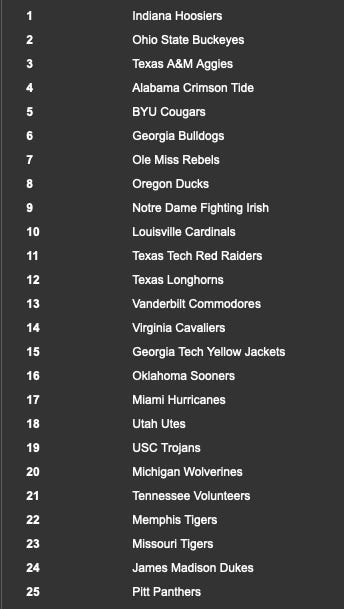
In retrospect, on this ballot (which I filled out at 2 a.m.), I’d probably have ranked things differently if I’d given it a bit more thought.
For example, I put together a few blind resumes that illustrate some potential eye-test bias. This one seems particularly relevant…
Team A: Two losses, No. 18 SoR, 4 wins vs. SP+ top 40, best win vs. SP+ No. 7, losses to SP+ Nos. 23 and 38
Team B: Two losses, No. 15 SoR, 1 win vs. SP+ top 40, best win vs. SP+ No. 12, losses to SP+ Nos. 4 and 13
I had Team A ranked 17th and Team B ranked ninth, despite Team A having a head-to-head advantage. But, of course, there’s some recency bias here. Notre Dame is playing well. Miami has lost two of three. The Canes’ resume clearly should have them ahead of Notre Dame but I can also see pretty clearly the issues offensively for Miami and the bubbling frustration with the play calling that is close to boiling over. It’s hard not to factor that in, even if, in a vacuum, there’s no way the Irish should be ranked eight spots higher.
Or how about this one, between two one-loss teams:
Team A: No. 10 SoR, No. 58 SoS, 1 win vs SP+ top 40, best win vs. SP+ No 6, loss to SP+ No. 54 by four
Team B: No. 13 SoR, No. 56 SoS, 3 wins vs SP+ top 40, best win vs. SP+ No 13, loss to SP+ No. 43 in overtime
This is one where I knew a good bit of the underlying data in advance and ranked them accordingly. Team A is ranked 11th for me (Texas Tech) and Team B is 10th (Louisville). What’s more interesting is if we use the AP poll rather than the SP+ data. The AP voters have Texas Tech at 9 and Louisville at 14, but those same voters think there’s much difference in their best wins (Utah is 16th, Miami is 17th — a far closer margin than SP+ suggests) and would certainly prefer Louisville’s loss to No. 12 Virginia than Texas Tech’s to unranked Arizona State.
OK, last one… both teams are undefeated.
Team A: No. 4 SoR, No. 46 SoS, 3-0 vs. SP+ top 40, best win vs. SP+ No. 6
Team B: No. 3 SoR, No. 33 SoS, 4-0 vs. SP+ top 40, best win vs. SP+ No. 14
I have Team B ranked No. 2 overall and Team A at No. 5. Honestly, I think that’s defensible, but the argument I hope to make with the blind resume is that BYU is much closer to Ohio State and Indiana than it is to, say, Texas Tech. That the AP has Oregon — seriously, look at who the Ducks have beaten — ahead of BYU is absurd. And if we want an idea of just how thoughtful the committee is going to be this year, BYU is the best team to watch. The Cougars have the No. 4 strength of record and are 19-2 over the past two seasons. If they’re behind the likes of Oregon, Ole Miss and Georgia — heck, even Alabama if we’re going to count the Florida State loss — then I’d say we’re in for a long month of propping up the SEC and Big Ten.
In any case, I’ll have the first Anger Index of the year reacting to the committee’s initial top 25 after the release Tuesday night. Should be fun.
Opening up the mailbag
Last week, I said we might do a reader mailbag at some point, but I must admit, I’m terrible about checking the comments. I’ll attempt to rectify that, but in the interim, we did have a good question from reader Brian A.
I can’t recall if you posited this before (I’ve followed you for many years as an ND fan), but is there a way to study turnovers? Specifically, everyone in football agrees turnovers lead to losses, but I swear I’ve seen data showing the team trailing by two scores or more commits more turnovers. Sort of a chicken & egg thing, possibly. But it might make for an interesting addendum to your momentum philosophy.
First, I dug deep onto my belief that momentum doesn’t exist in sports in what I think is still one of my favorite pieces I’ve ever written -- way back in 2021.1
But as for the turnover question, I dug into that a ways back, too, and statistically speaking, Brian is right. Turnovers are, in large part, based on luck and game conditions more than anything a defense does.
The math suggests things like pressure and sack rates have surprisingly little correlation to takeaways, while less intuitive metrics like yards per rush are a better predictor. Even the notion that turnovers dictate the outcome of a game offers something of a chicken-or-egg conundrum. Every FBS team has a positive turnover margin when already ahead on the scoreboard over the past decade, and only about a third of turnovers are committed by the team that’s ahead, with only about 14 percent from teams ahead by a touchdown or more. So are turnovers the key to winning or simply a byproduct of it?
“The analytics say that turnovers are way, way more random than coaches or fans think,” said Ed Feng, the curator of The Power Rank analytics service who has a Ph.D. in applied math from Stanford. “It’s not a perfect way to say there’s no skill. It’s just that turnovers are a really subtle thing, and randomness plays a much bigger role than people want to think.”
But, that story was from 2018, so I figured it was worth digging in to more recent numbers, just for the heck of it.
Let’s start with Brian’s specific example: Are you more likely to commit a turnover when you’re trailing by two scores than when you’re up by two scores?
Answer: Yes! For example, a team trailing by 10 points or more is about twice as likely to commit a turnover as a team up by 10 points or more. The variance increases the greater the lead or deficit.
This makes intuitive sense as a team trailing is a) likely to be the less talented team and b) is more likely to take risks in an effort to catch up.
But it also has something to do with another big issue: A pass play is roughly three times as likely to result in a turnover than a run play. Teams trailing by two scores are often in more of a pass-first mode, while teams up big are often running the ball more.
Of course, the notion that pass plays are more dangerous is obvious. On a run, you can only fumble. On a pass, you can fumble or throw a pick. But even that undersells the situation because, when just looking at fumbles, where a fumble happens on the field matters, too.
For example: Fumbles on designed runs are recovered by the offense roughly 58% of the time. Fumbles on dropbacks — either on a sack or after the catch — are recovered by the offense roughly 48% of the time. Fumbles on a completed catch 5 yards or more downfield are recovered by the offense just 35% of the time. Why? Well, the more offensive players around the ball, the more likely a recovery is made. Fumbles right around the line of scrimmage have a bunch of bodies nearby from both sides, making it a toss-up on who recovers. Fumbles downfield likely have multiple defenders nearby compared with just one offensive player.
Then, of course, there’s the issue of situational football, that again comes back to a run-pass dynamic. Example: First down plays result in a turnover once every 67 plays. Third/Fourth-and-long plays, however, result in turnovers about once every 25 plays. So, you’re roughly 3x as likely to commit a turnover when facing third-and-long than first-and-10.
I looked at the nine teams who were either one full standard deviation above or below the Power Four average in total turnovers this year, and they look much like you’d expect.
Of the teams who are turning the ball over the most, six are P4 average or worse in offensive EPA even when not turning the ball over, and all nine pass more often than the average P4 team, including six of the top 12 highest pass rates.
Of the teams that turned the ball over the least, only Iowa and Auburn -- two of the most run-heavy offenses in football -- are below average in offensive EPA when not turning it over, and five of nine throw the ball on less than half their offensive snaps. Only Alabama -- No. 9 highest pass rate -- is an outlier, which may be a reason to fade the Tide a bit moving forward. They’re perhaps due for a flukey turnover game soon.
One of my favorite bits of betting advice, by the way, is to look up which teams saw the biggest shift in turnover margin — or better yet, points off turnover margin — year over year, then take the over/under for the season in the opposite direction for the upcoming season. Luck changes, and turnovers are very heavily luck-based.
What’s David reading?
Well, Bill Belichick got ACC win No. 1 and all it took was playing a team using a lacrosse player at QB and, we assume, several members of a midwestern bowling league on defense. Good lord, Syracuse is bad. Anyway, prior to that win, when we were all still piling on, The Ringer’s Jordan Ritter Conn write about the misery of the Belichick experience.
I got some pushback from folks on Twitter when I posted a link to that story. I’m not sure who those people are or their reasoning for suggesting it, but I can say without question that, for many people involved in all this, life has been miserable since Belichick and Michael Lombardi arrived. But the biggest question is whether Belichick is miserable — or, perhaps, whether he enjoys misery? — and it’s really hard to tell because that does seem like his S.O.P.
Elsewhere…
I loved this piece for the AJC from my pal Fletcher Page on legendary Georgia strong man Paul Anderson, the town that helped raise him, and the tributes that still exist to his greatness.
GQ ranked the best albums of the ‘80s and I’m not going to waste any time arguing or trying to think of what was left off (OK, fine, Dire Straits “Brothers in Arms”) other than to say this: Fuck The Smiths, fuck Morrissey, it’s total crap.
My terrific colleague Max Olson has a fantastic piece out today looking at the journeys of journeyman QBs in college football, with deeper dives and really good insight from Chandler Morris, Tyler Van Dyke, Robbie Ashford, and Drew Pyne.
This week on Inside ACCess
We’ll be talking with NC State coach Dave Doeren about the Wolfpack’s shocking upset of Georgia Tech, why he loves this team so much despite the struggles, and what his future in Raleigh looks like.
We’ll also dig into what the chaos of Week 10 means for the playoff and have a few other surprises, too.
You can make sure you never miss an episode by subscribing to the podcast HERE.
ACC picks standings & tiers
I don’t have any big stories coming this week, but I will be in Charlottesville on Tuesday to talk with Chandler Morris for a piece airing on The Huddle this weekend. If you’ve got any good C-ville recs for me to grab a beer or a bite to eat while I’m in town, let me know.
Things are getting more than a bit crazy in the ACC after Week 10. For those wondering, here are the tie-breakers by rule.
I’m not sure I can fully break things down given the sheer number of possibilities, but a few items of note:
Because Virginia’s loss to NC State was technically a non-conference game, the Hoos remain undefeated in ACC play and control their own destiny.
Pitt plays both Georgia Tech and Miami still. Louisville plays both Clemson and SMU still. Louisville has a head-to-head tie-breaker with Pitt, but if Virginia ends up in the tie-breaker scenario, too, that could complicate things. The Cardinals are in a good place, however, as they’ll likely have an edge in the D-F tie-breakers if they win out.
Duke has Virginia, UNC and Wake remaining. All three are winnable for the Blue Devils, but Duke’s head-to-head loss with Georgia Tech is not ideal and it likely would not have any tie-breaker advantages. Best case for Duke is probably to win out and hope Georgia Tech isn’t part of any tie-breaker scenario.
SMU has BC, Louisville and Cal. The winner of the SMU-Louisville game will be in good shape, and SMU certainly is well positioned to win the other two. How crazy if that Wake loss is what keeps SMU out of the champ game? Of course, the good news is, Wake is unlikely to be a part of any tie-breaker scenarios, giving SMU a good chance at taking the first-tie breaker in a three-team scenario.
I don’t have “make the title game” odds from FPI, but the “win” odds are:
UVA, 31.6%
GT, 21.3
Louisville, 18.9
Duke, 15.8
SMU, 7.1
Pitt, 3.7
Miami, 1.6
No change this week in the bet to see who jumps out of a plane, but none of us did a good job of predicting the chaos of Week 10 in the ACC.
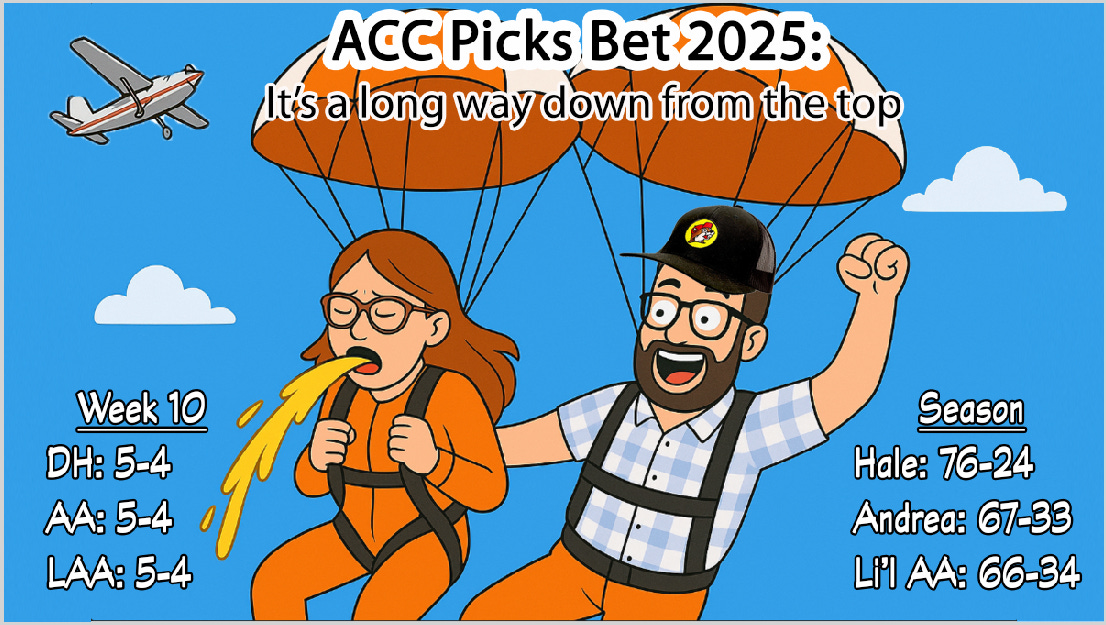
I did shake up my ACC tiers a good bit this week based on the fact that I think there are some solid but flawed teams, some teams that will give you a heart attack on a weekly basis, some teams that are too dangerous to overlook, and a whole bunch of meh. We turned to Metallica to offer our tiers.

And with that, let’s remember one of the great uses of Metallica in film…
RIP Mike Leach who contributed to that piece.