
Greener pastures
The transfer portal offers an opportunity to change scenery, get paid, and vault your profile. Or, it can be a complete disaster.

A few weeks back, I complained that portal coverage is rarely anything more than just reporting on transactions -- guy enters portal, guy visits schools, guy commits -- and does a poor job of informing fans about what’s really going on behind the scenes, offering real insight into the money involved, or doing anything at all to explain things on a more in-depth way.
Then, of course, the Darian Mensah saga unfolded and Dabo Swinney went to the mattresses on Ole Miss, and once again, it became clear why it’s such a problem that we -- as reporters -- treat the portal as if it’s just NFL free agency.
On the tampering end of things, the story’s gotten a little juicier as Fresno State seems to have receipts on Ole Miss, too.
I also came across this video from Virginia Tech’s Kemari Copeland on a school tampering with him in season pretty revealing. I do wish more athletes would be willing to speak candidly about their experiences. We still live way too much on the words of coaches and ADs and don’t hear nearly enough from players.

Mensah and Duke settled their legal dispute, allowing Mensah to enroll at Miami (with teammate Cooper Barkate, too). Max Olson and I reported that story for ESPN. I also spoke with Duke coach Manny Diaz1, who said he appreciated that the team needed to move past this situation and that there was “a buzz” in the building as the Blue Devils start offseason conditioning with a bit of a chip on their shoulders.
And from the folks I talked to at Duke, this was inevitable. As much as it was a clear-cut case of a player violating his contract (at the behest of another school), there’s just not much desire by schools to engage in protracted legal battles with athletes -- for PR, recruiting and preparation reasons. It’s just a bad look, which is why the players will continue to have all the leverage here. And while some folks at Duke felt that proving the validity of a contract at the college level was a worthy battle to have, ultimately it’s unfair to everyone there to ask them to be the canary in that particular coal mine.
I think there’s a ton of bigger questions surrounding the Mensah situation -- particularly as it pertains to how it impacts the QB market down the road, a story I’m hoping to dig into much deeper this offseason -- but the biggest initial questions really are just about what a contract means in this era.
For answers to that, we had law professor and college sports business expert Kristi Dosh on this week’s Inside ACCess, and she was extremely insightful.
In the clip below, Dosh explains why Duke’s case was’t nearly as solid as you might’ve thought, and why contracts may vary wildly from school to school or even player to player. This is really worth your time to watch... or better yet, hear the whole interview by subscribing to the Inside ACCess podcast HERE.
Among the other things we talked with Dosh about was this though: Why, given all the power they now hold, would players ever want to come to the bargaining table to set actual standards for player movement?
Well, one reason might be that the portal isn’t actually all that good for a lot of players.
We hear a ton about “Oh no there are 10,000 players in the portal!” and “What will this do to their educations?!?” and “won’t someone PLEASE think of the children!” but I rarely see any hard data on portal outcomes.
One reason for this is because tracking it is really difficult. There’s no such thing as a monolithic “portal experience.” A sizable percentage of guys are in the portal at a coach’s behest (another very underreported story). A lot of guys are looking for more playing time or there was a coaching change or they were at a smaller school and now think they can play at a bigger one or... well, the motivations can be all over the place.
So, what even defines a successful portal move? Again, I’m not sure there’s a blanket answer we can use for everyone -- and even a move that looks good today (Player X has a better year and gets more money) might ultimately be something they regret (they don’t graduate, don’t get drafted, and have limited future prospects).
But just because the task is difficult doesn’t mean we shouldn’t try to find some answers here, and one way I figured we could attack the problem is to ask a more narrow question. What happened to a smaller subset of transfers from 2024 on the field in 2025?
The wanted to find a fairly homogeneous group that would be easy to study, so I opted for ACC players who had at least 400 offensive snaps or 300 defensive snaps in 2024 who transferred to a different school for 2025.
This seems to me a good starting point because, while there are certainly all kinds of contextual differences here, it’s a group that didn’t need to transfer. They were playing for a Power Four school (though not one in the SEC or Big Ten) and were getting starter-level snaps (though not necessarily guaranteed them the next year). But either due to money or a coaching change or just a desire for new scenery, they all left a reasonably good spot in search of greener pastures.
So, how’d it go for them?
In all, our subset included 62 players -- 37 on offense and 25 on defense.
I charted all of their snaps year over year, along with stats in key metrics. Here’s what I found:
Of the 62 players, all but five transferred to another Power Four school. The exceptions were two QBs -- Anthony Colandrea (UVA to UNLV) and Maalik Murphy (Duke to Oregon State) -- one O-lineman (Ty Furnish from UVA to Georgia Southern), and two defensive players (Nahki Johnson from Pitt to Tulsa; Sam Brumfield from VT to Memphis).
Of the 62, 12 played notably bigger roles in 2025 than 2024, 22 played about the same, and 28 (45%) played markedly less at their new school. Of course some of this was injury related and we can’t ever be sure how things might’ve panned out had they stayed put, but that’s still a pretty high percentage of guys who were getting starter-level snaps, transferred, and then saw a notably smaller role the next year.
As for actual performance, that can be a little tougher to measure. Does having fewer sacks year over year alone suggest worse performance? Maybe, maybe not. But I still attempted to gauge who improved and who declined, and if it wasn’t entirely clear one way or the other, I put them into a “stayed the same” category.
Again, of our 62 transfers...
14 clearly improved,2 including some massive success stories like Fernando Mendoza, Mansoor Delane, Romello Height and David Bailey. Other success stories were more a matter of perspective -- Tommy Castellanos at FSU or KC Concepcion at A&M, who largely just reverted back to his 2023 numbers -- but they were improvement nevertheless.
15 stayed at roughly the same level3 of performance. This is a bit misleading, perhaps, as it includes guys like Tiger Bachmeier (didn’t do much at Stanford or BYU) and Luke Petitbon (was all-conference caliber at Wake and Florida State). A few guys -- like Keagan Trost or Bishop Fitzgerald -- were a bit harder to determine, too, because their stat lines were largely the same, they clearly improved their NFL stock and overall reputation on bigger stages.
In other words, 29 of 62 players either benefited or weren’t hurt on the field by transferring. Given that they also probably got more money, those are all success stories.
And yet, for 53% of our group, the story is far less upbeat.
By my estimation, 33 of 62 players saw a marked decline4 in on-field performance after a transfer. For some, it was simply about getting on the field at all (Jaydn Ott discussed this in vague terms at the Senior Bowl, in fact). For some, their numbers took a nose dive in a new system (Patrick Payton, Trebor Pena). And some still had OK seasons even if their numbers were definitely off from the prior year (Jack Endries, Isaiah Horton). So they’re not all in the same basket, and I’d wager that at least a handful of those 33 are still happy with the choice they made.
Still, even the most generous reading of this would suggest that, if you’re a player at the P4 level who’s already getting solid playing time, the odds that a portal move improves your prospects is probably no better than a coin flip.
So, should this be a big warning sign for players not to enter the portal too eagerly? I don’t know about that. It’s still a pretty small sample size, and some of the guys who saw regression -- Marvin Jones, Patrick Payton, Maalik Murphy -- needed to move on regardless. And certainly the success stories like that of Mendoza and Bailey -- arguably the best offensive and defensive players, respectively, in the country in 2025 -- should offer a hefty dose of “the risks are worth the reward.”
The short answer here though is probably that, even if an exercise like this doesn’t “prove” any points, it’s still worth doing -- and doing on a much bigger scale than I’m capable of managing in a free newsletter (though I learned enough from this brief exercise that I may want to see if I can dig deeper for a full ESPN story at some point).
Because the bottom line is that agents are here to tell players they definitely should move; coaches and ADs are too eager to talk about how bad all the movement is; and no one seems to be backing things up with much convincing evidence -- at least not publicly.
What else is David working on?
On this week’s Inside ACCess, we dug into our team grades/2026 expectations for...
Stanford
DH grade: C-
AA grade: C
‘26 expectation: Get better as the year progresses
Fan vote: 42% said 4-5 wins
Boston College
DH grade: D-
AA grade: D
‘26 expectation: 4 wins
Fan vote: 92% said 3-5 wins
Wake Forest
DH grade: A
AA grade: A
‘26 expectation: bowl game
Fan vote: 44% said 6-7 wins
Virginia
DH grade: A
AA grade: A
‘26 expectation: 8-9 wins
Fan vote: 52% said 7-8 wins
North Carolina
DH grade: D-
AA grade: D
‘26 expectation: 5-6 wins
Fan vote: 62% said “just less chaos”
and SMU
DH grade: B
AA grade: B
‘26 expectation:
Fan vote: 49% said compete for an ACC championship
We also had SMU coach Rhett Lashlee on (from the back of a car out on the recruiting trail!) who had lots of interesting things to say (again, listen to the full interview on the podcast HERE) but was also emphatic that he believes the Mustangs are capable of winning a national championship.
We’ll have another new episode digging into more grades & expectations on Wednesday at 5 p.m. on ACCN.
Also, I totally forgot to link to this in the last newsletter, but I was a part of our committee that put together the top 100 players of the 2025 season. I think we got them all exactly right yet again. Not sure how we keep doing it.
Lastly, a quick newser: The Fiesta Bowl is hosting a first-of-its-kind women’s flag football tournament for 8 D1 schools in April.
What’s David reading?
Some good things I read elsewhere in the past few days...
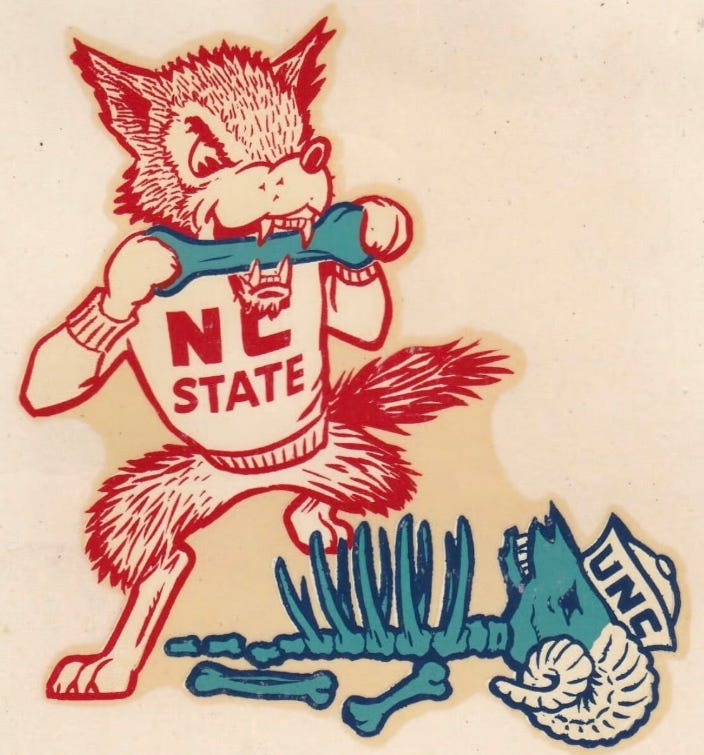
One of my favorite newsletters -- Jeremy Markovich’s NC Rabbit Hole -- digs into the backstory on this photo of the NC State wolf appearing to eat Ramses rotting corpse. And the story just finds more and more amazing old-school mascot hijinks, including the Blue Devil stabbing the Deacon in the ass with his pitchfork.
What was your peak year for music? I could probably say 1993, as it was at the height of the grunge era and I was just starting high school, but I could also make a good case for the late aughts -- 2006-2010 specifically -- when I embraced indie rock with all my heart. So, of course, Steven Hyden’s look back at the best indie albums of 2006 was right up my alley and I certainly can’t quibble with anything he writes here (except that I’m still very much in the “gonna walk around, gonna walk around, gonna walk around and drink” vibe of Hold Steady appreciation and also I’d have TV on the Radio a good bit higher than 15. But I also think we both agree wholeheartedly on No. 1.
There’s a fight brewing in Key West to preserve Jimmy Buffett’s old recording studio. For my money, Buffett, Mike Leach, Ernest Hemmingway and Captain Tony ought to have their own Mt. Rushmore in the Conch Republic.
One of the founding voices of AI says Silicon Valley is marching toward a dead end. This is always what’s confused me about the massive investment in LLMs. I see their value, but if the end goal is general or super intelligence, LLMs don’t seem to be the path to get there.
And speaking of AI — I think there’s a good chance social media is just completely cooked in the next few years, when the bots will completely outnumber the actual humans.
Duke is waiting on NCAA clearance on Walker Eget, whom they signed out of the portal from San Jose State, but he’s still recovering from a late-season leg injury and it’s not clear when he’ll be a full go. That leaves Daniel Mahan at the top of the depth chart for now.
The full “success” category: Anthony Colandrea, Fernando Mendoza, Tommy Castellanos, KC Concepcion, Malik Benson, TJ Ferguson, Howard Sampson, Brandon Cisse, David Bailey, Jamare Glasker, Jayden Bellamy, Mansoor Delane, Romello Height, Sam Brumfield
The “stayed the same” category: Nyziah Hunter, Tiger Bachmeier, Austin Collins, Keagon Trost, Luke Petitbon, Matt Gulbin, Nick Sharpe, Ugonna Nnanna, Amare Campbell, D’Yoni Hill, Bishop Fitzgerald, Maraad Watson, Nahki Johnson, Syeed Gibbs, Tamarcus Cooley
The “performed worse” category: Maalik Murphy, Ashton Daniels, Jaydn Ott, Star Thomas, Dacari Collins, Emmett Mosley, Eric Singleton, Horatio Fields, Isaiah Horton, Jack Endries, Johnathan Brady, Malachi Fields, Trebor Pena, Blake Steen, Bob Schick, Braelin Moore, Corey Robinson, J’Onre Reed, Jake Maikkula, Luke Baklenko, Ty Furnish, Xavier Chaplin, Beau Atkinson, David Reese, George Rooks, Jaden Harris, Kamal Bonner, Marvin Jones Jr., Mose Phillips, Patrick Payton, Ryland Gandy, Sincere Edwards, Travis Shaw
Have you listened to Midlake’s ‘Trials of Van Occupanther’ on that list? The song ‘Roscoe’ off that album is so good. And obviously, Okonokos kind of changed me forever.
How can you say 1993 was the best year in music, when Spacehog wasn't even together until the following year? /s