
The picks are in
It's tournament time. Here's my terrible bracket, along with some good insight on Duke's run from AD Nina King, Virginia's second act from Tony Elliott and this week's best reads.

It’s NCAA tournament time, which is unquestionably the best weekend of the year and, as it turns out, a reminder that it’s been effectively one year since I started this newsletter. My second post was about the nostalgia that comes with running a tournament pool for many, many, many years.1
I’m running that pool again, and I’m happy to invite y’all to join if you can get your picks in by noon and are willing to shell out $10 per sheet (max 3 sheets, send money via Venmo to @David-Hale-17). You can join HERE.
I have gotten to a point where I just do one sheet per year, in my own pool, and I don’t win. That’s OK. I’m not really trying to win. I want to just be a part of something bigger than myself. But, if you’re curious, here’s who I picked…
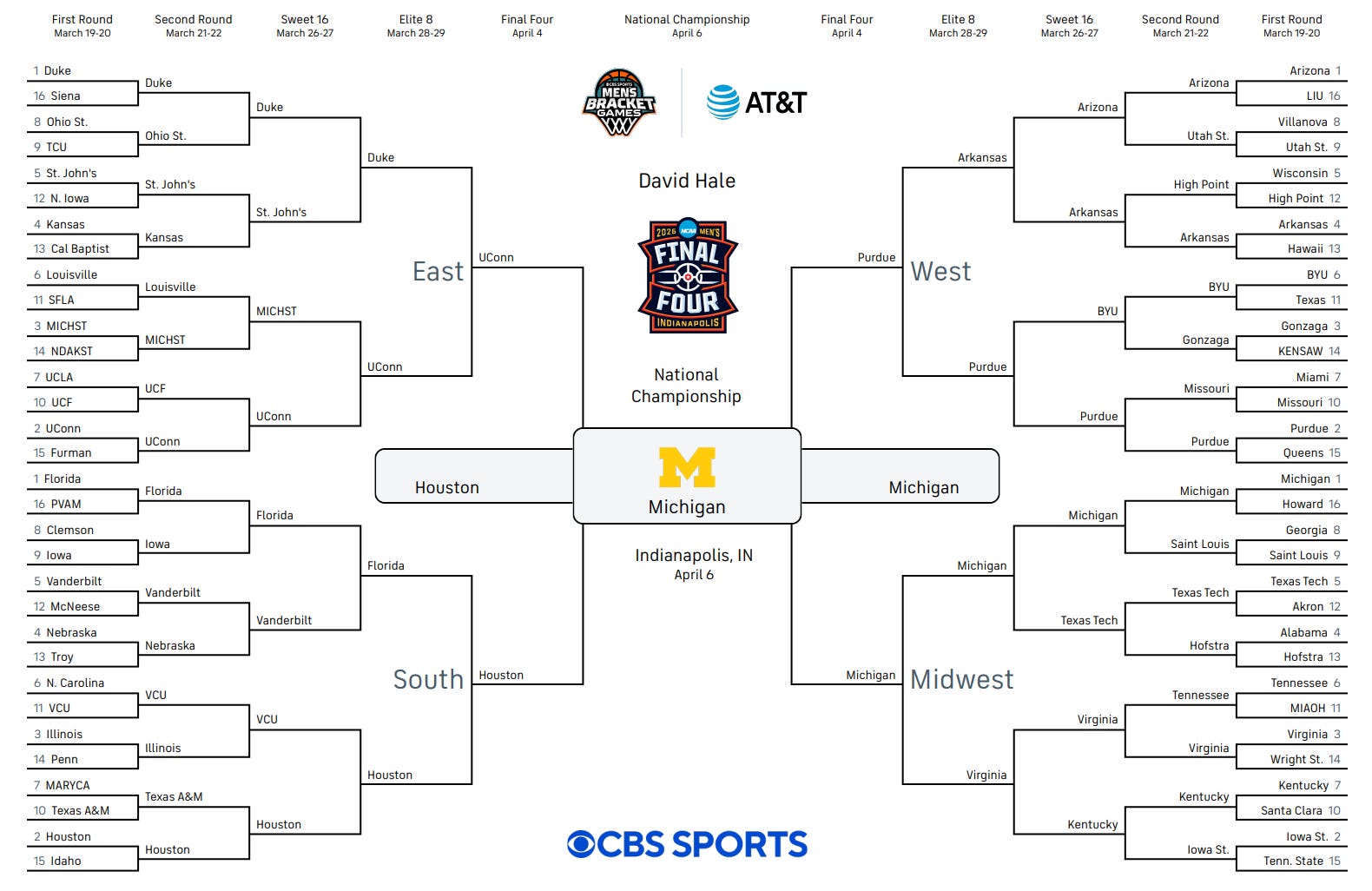
On that front, I’ll be at the first two rounds of the NCAA tournament this weekend, starting today in Greenville, S.C.
A couple quick thoughts on Greenville:
1.) Being ticketed for backing into a parking spot is some bullshit. For one, if you’re already in a paid parking garage, why is anyone ticketing at all? Secondly, the presumptive reason for this measure is so people ticketing your car don’t have to put the effort in to walking around your car to view your tags, which seems to me the least someone can do before fining you $50 for parking.
2.) I had dinner at Jianna, which was fantastic. Greenville is a sneaky good food town. Highly recommend.
Anyway, because of my basketball obligations, this week’s newsletter is coming to you on a Thursday, and it’s an abridged version. You get what you pay for. Alas...
Who’s David talking to?
On this week’s Inside ACCess, we welcomed Duke AD Nina King to discuss the unprecedented success the Blue Devi
ls have had in the ACC this year.
Duke has won the football, men’s basketball and women’s basketball conference titles all in the same academic year. That hadn’t ever happened in the ACC. It hasn’t happened in any major conference since UConn did it in the Big East in 2010-11 (though Oregon might’ve done it had the Pac-12 tourney not been canceled in 2020). It’s happened only three other times total at a major conference since women’s basketball became a widely played D1 sport.
And the key, King said, is having the right people at the top of the program.
We also welcomed Virginia head coach Tony Elliot as the Hoos open spring ball following an 11-win campaign. Elliot talked about the team’s quest to pivot from the climb to appreciating what it takes to stay at the top.
Next week, Andrea and I will be in Miami as the Hurricanes open spring ball, with (fingers crossed) interviews with Mario Cristobal, Darian Mensah and much more.
And remember, you can keep tabs on all of this by subscribing to the Inside ACCess podcast HERE.
What’s David reading?
- I have never read a rankings list -- for sports, music, movies, whatever -- and found myself nodding in agreement all the way through.
Until now.
Steven Hyden’s ranking of Sturgill Simpson albums seems to me to be spot on, exactly how I’d rank them, for exactly the reasons he cites.
As a side note, I think me and Steven would be great pals if we ever met, routinely drinking too much booze while deliberating on important items like the best Decembrist’s song over 6 minutes long (”Mariner’s Revenge”) or ranking the members of Arcade Fire 1 through 47 until our wives determined we weren’t allowed to hang out anymore.
- I’ve long said there’s never been a movie or TV show that hasn’t been made better by having John Lithgow in it. He is like a top-tier shooting guard. You can build a project around him, but he also blends perfectly into any cast and makes everyone around him look better. The New York Times gives him the praise he deserves. But my favorite part of this story, which goes deep on why Lithgow chooses difficult, often controversial roles, is this:
Why, with nothing left to prove, does he make such a beeline for such potentially divisive gigs?
“I am fascinated by every variety of human experience and want to understand it,” he said. “I’m in the empathy business.”
People like to call the media biased for the left. I don’t agree with that as a principle, but I do see where it comes from. To be a great actor or a great reporter, you must be in the empathy business, and I think empathy requires you to view the world through a prism that most would call “leftist.” But as this piece on Lithgow shows, that’s hardly true in all cases. The point is seeing the humanity in everyone, and attempting to understand them as people rather than stories.
- No story got more buzz over the last week than this piece in The Atlantic, where writer McKay Coppins was given $10,000 to gamble at will to learn what the life of a shitty gambler was like.
I have so much to say about this piece, and there’s no chance I’ll cover it all here. But part of me feels like it falls into that trap of deciding to do a big, longterm story on something, getting most of the way through it and realizing it’s not as exciting as it should be, and then ratcheting up the stakes just to make the story work.
But at the same time, it’s pretty clear that there are massive problems with the current legalized gambling lifestyle. I think there’s a bigger story to be told about legalized porn, gambling, weed, etc. and the impact it’s had on people who used to be kept at arm’s length from this, and how many supposedly liberal ideas are really being shown to have major flaws, just as they’re being embraced by the conservative MAGA movement.
But, if we’re getting into the nitty gritty of this piece, there are a few things worth pointing out…
In 2017, Americans legally bet $4.9 billion on sports. Last year, that number rose to at least $160 billion—and once you’re hooked, the list of sporting events you can gamble on is seemingly endless. Unsatisfied with wagering only on Sunday football games? Not to worry: How would you like to bet on an Indian cricket match, or Lithuanian Ping-Pong, or a Polish soccer game in a league whose name you can’t pronounce? In 2023, an offshore book called BetOnline briefly allowed people to gamble on the Special Olympics.
So, yeah, we have a problem. But the problem is largely centered around young men, and more than that, around young men doing very dumb stuff. I have a buddy who used to bet Australian tennis because it was the only thing he could bet on at 2 a.m. There should be bigger impediments to stupidity. I realize that we’re a free country, but I think if people had to spend, say, 8 seconds thinking about the dumb thing they were about to do, a lot of them might not do it.
Gambling had made us all care much more about the games, but it had also atomized us—taking the last and purest expression of American monoculture and turning it into a hyper-individualized, every-man-for-himself portfolio of micro-bets.
As someone who likes the occasional wager for fun or communal enjoyment, the microbetting trend has utterly ruined gambling for me. I find it no fun to see people wagering on rushing yards or passing TDs. I like over/unders, game totals, half totals… that’s a thing we can all wrap our heads around. When you’ve gone more micro than that, I think you’ve lost me.
Sports leagues, of course, are not the first American institutions to suffer a crisis of authority in the 21st century. (See also: Wall Street, Congress, the military, the police, the press, etc.) But the recent decline of trust in sports is, to an extraordinary degree, self-inflicted and avoidable. By embracing gambling so completely—normalizing it, celebrating it, reaping massive profits from it—the leagues have all but ensured that many fans will see it as baked into the game itself. Even if point-shaving is rare, each new revelation reinforces the notion that the system is rigged. To watch sports in 2026 is to become, almost inevitably, a kind of conspiracy theorist.
I also think this is relevant not because I think it’s true, per se, but because public perception is more important than the truth in many cases.
Again, limiting the range of things you can bet on seems like a no-brainer to me. I’m in no way against legalized gambling. I think it’s a net win. Maybe I’m wrong and I’m open to that evidence. But there seems to me to be some very easy steps to avoid the worst case scenarios, and we’re just choosing not to take them.
Another longtime pool participant, my pal Phil, passed away this year. That’s at least 5 of the folks who’d signed up over the years who are no longer with us.
Thanks for this interesting post David.
I'm not bold enough to fill out a bracket, but for those that do, consider:
It takes six wins in a row to get a national title. Of the 68 teams, ten of them have not even won six in a row, from the regular season into conference championships. I would bet (though not really, I don't bet) against all of them and would rather have more deserving schools in the bracket -strength of schedule be darned.