
The year we got it all wrong
A look back at the QB recruits of 2022 -- perhaps the most confounding year of player evaluation in recent college football history.

If you’ve followed me on Twitter over the past few years, you may have seen me note my quasi-obsession with the QB recruiting class of 2022. Part of my interest in this stems from having spent a lot of time around the No. 2 QB in that class, Cade Klubnik. I also wrote on the No. 1 QB, Drew Allar, before the 2024 season. Both QBs turned out to be solid college QBs who each made the playoff once and ultimately fell well short of high expectations.
But that’s just the tip of the iceberg for this class, which might be the worst predicted group of QB recruits ever -- and as I continue to work on a few potential stories surrounding the players in this class, I thought it was worth a deeper look at the numbers.
First, there’s this: ESPN’s Matt Miller has a two-round mock draft up that currently has two QBs from the 2022 class mentioned.
The first is Fernando Mendoza. He’s likely to be the first pick in the draft.
The second is Ty Simpson. He’s pegged as the second QB off the board -- but not taken until the second round at No. 44.
Simpson was, according to 247, the No. 4 QB prospect of 2022.
Mendoza was... No. 134.
And that perfectly sums up this class.
If Simpson is not taken in the first round, the 2022 class will be the first QB class without a first-round draft pick among its top 20 prospects since 2010.12
The list of guys at the top of the ‘22 class who’ve disappointed or flat-out disappeared is long:
Allar and Klubnik were 1 and 2. Conner Weigman, who was a mixed bag at Texas A&M before transferring to Houston and having a solid 2025 was No. 3. Gunner Stockton was No. 7.
The rest of the top 20?
Devin Brown (1 career start, transferred from Ohio State to Cal and now at Weber State)
Walker Howard (1 career start, transferred from LSU to Ole Miss to Louisiana and back to Ole Miss)
Nick Evers (8 career starts, transferred from Oklahoma to Wisconsin to UConn and now at Missouri)
Maalik Murphy (22 career starts, transferred from Texas to Duke to Oregon State)
Brady Allen (0 career starts, transferred from Purdue to Louisville and now at Indiana State)
Katin Houser (26 career starts, transferred from Michigan State to ECU and now at Illinois)
Tayven Jackson (16 career starts, transferred from Tennessee to Indiana to UCF and now at North Texas)
AJ Duffy (0 career starts, transferred from Florida State to San Diego State to New Haven)
Holden Geriner (0 career starts, transferred from Auburn to Texas State and now to Pitt)
Sam Horn (0 career starts, still at Missouri)
Jacurri Brown (5 career starts, transferred from Miami to UCF to Rice)
Justyn Martin (1 career start, transferred from UCLA to Maryland and now at Ohio State)
Zach Pyron (5 career starts, transferred from Georgia Tech to South Alabama)
Jayden Denegal (12 career starts, transferred from Michigan to San Diego State)
Garret Rangel (5 career starts, transferred from Oklahoma State to Virginia Tech to UT-Rio Grand Valley)
So, to recap, that’s 11 of the top 20 QBs in the class who started 8 or fewer college games through their first four years. Thirteen have transferred down to Group of Five or FCS. And all but Klubnik, Allar, Simpson, Stockton and Horn have transferred at least once, with 12 of the top 20 transferring at least twice.
Klubnik and Allar have 75 Power Four starts under their belts as they depart college ball. The rest of the top 20 have started a total of 110 games at the Power Four level -- an average of 6 per QB. After four years.
And honestly, it gets worse. The only guy from Nos. 21 through 39 who looks like he’ll have a Power Four starting job in 2026 is Beau Pribula, also on his third school after transferring to Virginia this offseason. The rest are... bleak.3
But then things get interesting, because 2022 was not a bad class -- just a poorly evaluated one.
No. 40 on the list is Noah Fifita, a solid and occasionally excellent college QB who’s played his whole career with Arizona.
No. 42 is Josh Hoover, an excellent player at TCU who just got paid big money to leave for the national champs.
No. 43 is Steve Angeli, who’ll be Syracuse’s starter again this year after an injury upended a promising 2024.
No. 57 is Ashton Daniels, set to be Florida State’s starter this year and a guy who’s started for three years prior at the Power Five level.
No. 61 is Rocco Becht, an excellent QB at Iowa State who followed Matt Campbell to Penn State.
No. 64 is Jayden Maiava, who enters his third year as USC’s starter and who posted a 89.9 Total QBR last year, second-best in FBS.
No. 75 is Byrum Brown, coming off a sensational year with USF and poised to take over at Auburn.
No. 101 is Brendan Sorsby, who just got paid bank to transfer from Cincinnati to Texas Tech.
No. 124 is John Mateer, an early Heisman favorite who helped Oklahoma to the playoff.
No. 132 is Kevin Jennings, a star at SMU who’ll be one of the top QBs in the country in 2026.
And, of course, there’s No. 134, the Heisman winner and national champion, Fernando Mendoza.
A ton of other very good Group of Five QBs are in that mix, too, including Caden Veltkamp (No. 68), Owen McCown (No. 74), Brayden Fowler-Nicolosi (No 99), Maddux Madsen (No. 110), JC French (No. 140), EJ Warner (No. 152) and Alonza Barnett (No. 179).
The guys ranked 39th or better4 listed above have a career record of 273-186 (.595) and helped win games at places like Indiana, SMU, USF, Iowa State and Arizona. (Those five schools had a .488 record in the five years before the 2022 class arrived, and Mendoza, Jennings, Brown, Becht and Fifita have combined to post a .673 win percentage there).
Here’s a really fun fact: QBs ranked 100 or higher in this class have started seven playoff games. QBs ranked in the top 50 have started eight (and it’d be seven if Carson Beck hadn’t been hurt for the 2024 Sugar Bowl).
Indeed, as we look ahead to 2026 -- theoretically the final year of eligibility for any Class of ‘22 QB -- the guys ranked 39th or better are slated to be starters at four Power Four schools. Guys ranked 40th or worse are the likely starters at 11, including five teams that have made the playoff in the last two years.
So what happened here?
I think it’s a perfect storm of a lot of things. These guys saw their junior years completely upended by COVID-19, making scouting much tougher during the most critical year for recruiting. They were also the first class to arrive in peak portal era, so fewer and fewer opted to stay somewhere and learn on the job (as Simpson did) before taking over and more and more had to deal with coaches happy to chase a veteran in the portal to replace an exiting starter. And the extra COVID year for players meant there was a host of veteran QBs ready to take spots that might’ve otherwise gone to younger players.
Still you’d think the 2021 and 2023 classes would have seen somewhat similar results, but they haven’t. All recruiting classes come with their share of misses, but 2021 produced four first-round draft picks among the top 20 QBs. 2023 is shaping up nicely, too, with Arch Manning, Nico Iamaleava, Dante Moore, Aiden Chiles, Avery Johnson, Christopher Vizzina, Sam Leavitt and Marcel Reed all among the top 20 from that year. Heck, if Moore had gone into the draft as many hoped, the 2023 class would have more first-round picks already than the 2024 class.
And on the flip side, dig into the deeper ranks of those classes and the best QBs you’ll find at No. 100 or higher are Darian Mensah (No. 112 in 2023) and... Billy Edwards Jr.?5
So, what’s all this mean? Probably nothing. For me, it’s more been just a fun quirk to follow for the last couple years.
More than anything though, it’s another in a long, long, long line of crazy stories that started with COVID-19. It’s amazing to me how often I talk to players and coaches and ADs who still shake their heads at all college sports went through in 2020 -- which, let me be clear, was hardly the worst things to happen in 2020 -- and I feel like we’ve largely just moved on without really appreciating the impact. How many guys failed to develop? How many guys were overlooked? How many coaches got fired? How many programs were set back or, maybe, jump started?
At some point, someone needs to write a book -- or at least a really long story -- on the 2020 college football season. I hope that person isn’t me because it sounds like a lot of work. But someone really should do it.
From this week’s Inside ACCess
We talked with new FSU QB Ashton Daniels, including his explanation for why he had an Auburn backpack on his Tallahassee visit in December.
Assuming Daniels is FSU’s QB1 to open the season -- or even if it’s Kevin Sperry -- it’ll be the Noles’ seventh different starting QB in their last 29 games.
Here’s the awfulness since Jordan Travis’ injury:
Tommy Castellanos (12 starts) 5-7, 62.5 Total QBR, 24 TD, 11 TO
Brock Glenn (7 starts) 1-6, 26.1 Total QBR, 6 TD, 10 TO
DJ Uiagalelei (5 starts) 1-4, 36.5 Total QBR, 4 TD, 6 TO
Luke Kromenhoek (2 starts), 1-1, 36.5 Total QBR, 3 TD, 4 TO
Tate Rodemaker (1 start), 1-0, 43.8 Total QBR, 0 TD, 0 TO
We also talked with our colleague Eli Lederman on how James Franklin built his first recruiting class at Virginia Tech -- i.e. raiding Penn State’s recruiting class.
Check out Eli’s story on Franklin’s class HERE. It’s worth the read.
And lastly, we chatted with Brent Key on what he was looking for in rebuilding a new defensive coaching staff and personnel.
But you should probably listen to the whole thing on the podcast HERE because we also discuss Bruno Mars for some reason and Key talks about what signing day was like when he worked for George O’Leary.
Next week, we’ll be spending some time on developments from the ACC’s winter meetings which will include discussions with the director of the College Sports Commission, vote (we hope) on tie-breakers, 2027 schedule and beyond, and more.
Also this week, we gave out our ‘25 grades and set our ‘26 expectations for six more ACC teams.
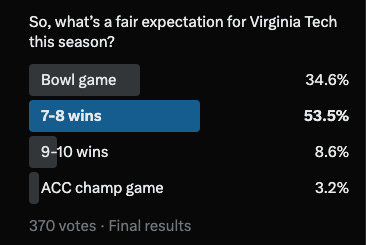
Virginia Tech
DH grade: D
AA grade: D-
Fan expectations:
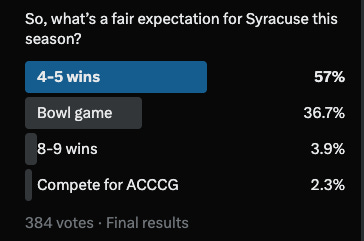
Syracuse
DH grade: D
AA grade: D-
Fan expectations:
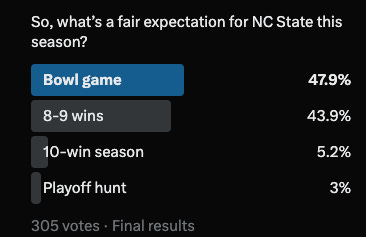
NC State
DH grade: B-
AA grade: B-
Fan expectations:
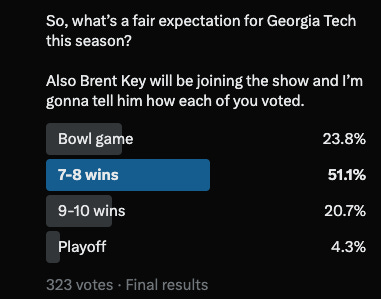
Georgia Tech
DH grade: B+
AA grade: B
Fan expectations:
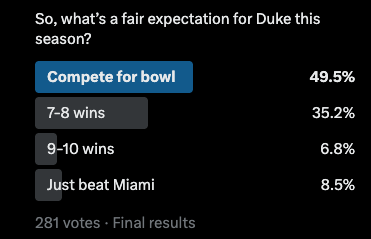
Duke
DH grade: B
AA grade: A
Fan expectations:
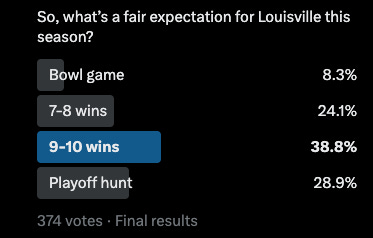
Louisville
DH grade: B
AA grade: B
Fan expectations:
What’s David reading?
Florida State is carrying the most debt of any athletics department at a public university in the country, though a lot of it is about capital improvement projects.
My one big takeaway from this, however, is something that I’d wager is true at a lot of schools these days:
Roughly 16% of its expenditures were covered by campus subsidies—$33.9 million in direct institutional support and an additional $8.6 million via student fees. This kind of funding is atypical for FSU. In FY24, the school reported just $107,337 in direct institutional funds going to athletics. Outside of the COVID-affected FY22, when the department received $13.6 million from the university, the largest prior contribution from main campus was $1.66 million in 2018-19.
Turner told Sportico that the institutional funding was used to support Title IX initiatives, athlete-related expenses and legal fees tied to the ACC litigation. He added that enhanced accounting and new reporting practices also impacted the numbers.
In June, FSU became the first school to take advantage of a new state law enabling schools in Florida to shift funds from other campus sources to athletics to cover athlete revenue-share payments provided for in the House v. NCAA settlement.
That we’ve gotten to a point where, as Americans are increasingly struggling to afford college, more and more are opting out of it completely, and universities are feeling budget crunches everywhere, we’re getting a wave of schools who are now funneling university funds -- including student fees -- to subsidize payments for athletes now making 6 or 7 figures is... well, not great, Bob.
On the other hand, there are better ways to generate revenue, like this guy who broke into a Little Caesars in North Carolina during last week’s blizzard and started making and selling his own pizzas. If that’s a crime, then ... well, no, I see how that’s a crime. Still, the guy had business savvy.
The flaming husk of the Washington Post has a deep dive on the experience of dining at five of the country’s oldest restaurants. I’ve never been to any of them -- an oversight I should attempt to correct in 2026.
There’s a popular notion that the “inflation” in food prices is largely tied to an increased reliance on DoorDash. This piece digs into the hard data to show that, nope, it’s groceries that have gotten more expensive.
And this was one of the more fascinating stories I’ve read in a while. As we move forward with LLM AIs, there’s a discussion to be had about whether these systems can become “conscious.” The short answer, I think, is no. But AI is also forcing us to grapple with the far bigger question: What exactly is consciousness in the first place?
A quick thought on the WaPo layoffs
There was a lot of righteous indignation about the layoffs of 300 people from the Washington Post this week -- along with shuttering the entire sports section -- with a bunch of performative hand-wringing on social media from journalists and pundits.
I’m sympathetic to all of it, but I’m just past the ability to be outraged. I’ve seen it too much.
Is Jeff Bezos running the paper into the ground? Of course. But that’s been ongoing for years now. I canceled My WaPo subscription more than a year ago because of frustrations over its editorial direction.
Is management there capable of running a media outlet credibly? It certainly doesn’t seem so.
Were there lots of incredibly talented journalists there who are now out of a job? Absolutely.
And yet... how is this different than what the New York Times did in shuttering its own sports department after purchasing The Athletic? Or the gutting of another American institution in Sports Illustrated? Or, more fittingly, the utter destruction of virtually every local print project in the country (and, frankly, TV and radio aren’t far behind).
There is definitively a problem with how rich guys and private equity firms are running media companies these days. But I’m not sure what being mad at billionaires is getting us. If performative outrage is all it’s about, then mission accomplished. If finding solutions that can create a sustainable model for real, dedicated, thoughtful, nuanced journalism is the goal, then it’s accomplishing jack squat.
There’s a far bigger issue that no one seems to want to acknowledge, which is that journalism -- like so many other American institutions -- has been destroyed, demoralized, and defunded for so long that an entire generation of consumers has been trained to ignore it completely and search for information elsewhere.
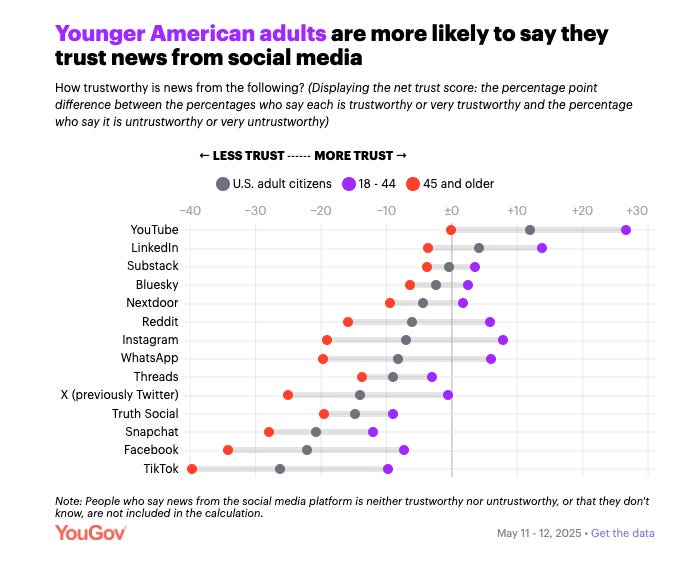
As a result, virtually no one is consuming print media anymore, making it impossible to even a well-run organization to float a workforce the size of the Post’s.

In sports, for example, the interest in deep dive reporting or daily beat work has dwindled dramatically in an era when highlights are on your phone instantly and transactions are reported via social media before there’s a story online. Meanwhile all that work to cover a beat costs A LOT of money — from travel to editing to design and photos.
And for what?
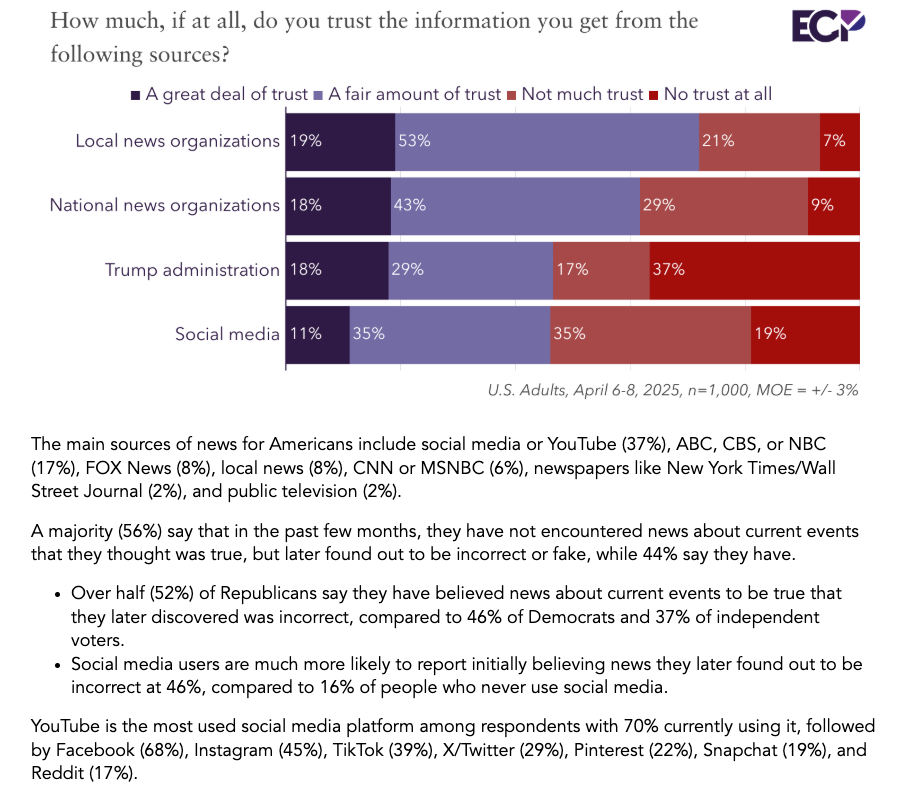
And, as the WaPo folks framed as “not reaching all audiences,” there’s a massive issue in which people simply want to be told what they already believe, and social media fills that gap far better than actual journalists do.
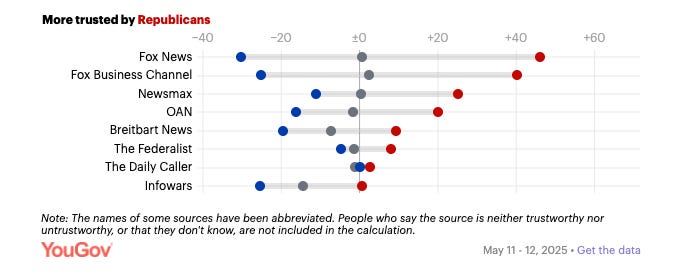
So, as I noted on Twitter (not ironically) after the layoffs, the issue we face is not one that can be solved on the supply side. There’s nothing the Post could do to bring back print media users. Even the New York Times, which has gained a lot of new digital subscribers, is being kept afloat in large part by The Trump Outrage Machine (something that closely echoes social media but will ebb significantly when the Trump era ends), Wordle and Wirecutter articles that maximize SEO.
The bottom line: We live in a bleak time in which people do not want journalism. They want something that fires off that little shot of dopamine that makes them feel righteous or angry, not informed. We’re trying to sell very expensive vegetables to a world addicted to free candy.
From 2017 through 2021, every QB class top 20 produced at least two first-round NFL draft picks. 2016 had just one (Dwayne Haskins) but also gave us Jalen Hurts. That also came on the heels of a 2015 class in which five of the top 20 QBs were taken in Round 1 (plus three others who have started NFL games). Weirdly from 2012 through 2014, there was just a single first-rounder in each: Jameis Winston from 2012, Mitch Trubisky from 2013 and Deshaun Watson from 2014. Um… #goacc?
2010 didn’t have a first-round QB but it did produce the Eagles new OC, Sean Mannion. It also had Blake Bortles at No. 66, who went in the first round.
MJ Morris! Conner Harrell! Henry Belin! Again… #goacc
Yes, 39 is arbitrarily chosen because of Fifita but if you want round numbers I’m sure there are better newsletters out there than this one.
Of note: General Booty was the No. 137 QB in 2021 and on name alone warrants inclusion among the greats.
As an OU fan, Mateer was not initially as overrated as you might think...
As a guy whose hometown print newspaper folded last week, oof.